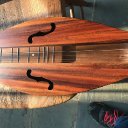
scalloped fretboard
Instruments- discuss specific features, luthiers, instrument problems & questions
Wood has a mind of its own. :)
Wood has a mind of its own. :)
yes floating bridges are the way to go
what ken said. properly constructed instruments will not warp.
The short answer, yes. The long answer, for most players it is one additional feature they need to worry about, will only modestly improve their play and generally makes them more frustrated.
If you plan to play many different styles of music, perhaps. It really comes down to how much time you want to spend messing with your instrument for a modest improvement in sound. Some people obsess over the tiniest improvement, some people say, close enough for rock and roll.
I'm going to to disagree with Ken here. I haven't owned scalloped-fretboard instruments long enough to notice any issues, but I can think of three people I know, very well respected in the dulcimer world, who have been playing instruments with and without scalloped fretboards longer than I've been alive, and it is their opinion that over time, those scalloped fretboards do (and in the case of some builders, WILL) warp. And they each told me that independently, over the years I've known them. In fact, it's not even an opinion; two of them have shown me examples.
I am wondering now if it would be better to have floating bridges rather than fixed bridges?
(re-glue the fretboard back on the cardboard )
thanks patty but it's not the fretboard, it's the seems on the sides glue to the top & glue to the bottom.
Maybe it could be fixed but I'm wanting to know if I can take the fretboard and put it on a flat board, like a possum board
Depending on the glue, you may be able to warm it up to soften it. Then you can re-glue the fretboard back on the cardboard without the gaps. Here is the link to Backyard Music. I've sent emails to them and they've been good about answering back. Sometimes you have to give them a couple of days in case they are busy.
http://www.backyardmusic.com/Welcome.html
The seems are not sealed, there are gaps all alone the seems. I painted it & it looks interesting but I was wondering since there are so many of the seems open, if I should see if I could put the fretboard on something else. The fretboard is fine, it's the seems.
Hi Marg, I have a cardboard dulcimer that I put together myself. I'm not sure what you mean when you say the sides do not match up. Are you saying it's out of alignment? Not sure if the fret board could have been glued on properly if that's the case. If you can provide a picture that would help. I think if it sets in a warm environment the glue may soften but I would try to reposition the fretboard on the cardboard to keep it on the cardboard. I like my cardboard. It's unique. I acquired mine from Backyard Music. You can send them an email of your intentions and they can tell you what will work.
Friends, get your Public Domain or original tune or song ready! August 26 is the day. And if you don't have a porch, just go outside someplace. :)
I have a cardboard dulcimer given to me, lots of places that the sides do not match up. I was thinking of trying something and looking for your help or ideas or even if it would work.
Can I cut the fretboard away from the cardboard and place on something like a possum board? Maybe stick on a pick up to amp it - if sitting on a board there isn't enough sound?
I was able to make contact with some folks that knew Robert, they were kind enough to respond. Dulcimer people are great.
Below is what I found out:
" I knew Bob (Robert) LaFever on a casual basis. He had a shop at the Folk Center in the 1990s. I worked next door. He made some high quality dulcimers when he could. Although a lot were budget models, in order to make and sell quickly to tourists at the park."
One of the kind dulcimer folks I was able to speak with is Robert or Bob Momich, who was at the Folk Center in the 80's. He hasn't made any dulcimers in years but is hoping to get back to it, he says he has enough parts to make maybe 200. He was so interesting speaking with him, I hope he does start making dulcimers again. He moved away from Mt. View, ARK & is on the East coast now.
Uh, yea, the article on frets.net is confusing. Try going to Stewmac.com (a site everyone who builds instruments visits from time to time) and type in saddle. A much more authoritative source.
Maybe the play Flop-eared Mule and other songs that use the 9 & 11 fret?
It determines where McSpadden glues the bridge. Read this page: https://www.mcspaddendulcimers.com/kb_results.asp?ID=6
As a practical matter, compensation is more of a concern when:
1. You have a short-scaled instrument (like a 23" Ginger)
2. You are playing higher up the fretboard (in the second octave)
3. You are fretting more than one string (noter/drone don't care unless the intonation is way off)
4. You have a sensitive ear and notice when strings aren't quite in tune with each other
FWIW, my Ginger was compensated for GDG. When I string her DAD the intonation's OK for me in the first octave but I notice it's off in the 2nd octave. I know someone who tunes his Ginger DAA but had her compensated for that.
If you're ordering a standard 28" McSpadden and you retune between DAD and DAA often, I wouldn't worry about it. If you tend to play drones in DAA and chords in DAD, then compensate for DAD.
I've heard enough arguments about "bridge" vs "saddle" to leave me totally confused. According to Frets.com, no wonder: http://www.frets.com/FretsPages/Musician/Guitar/Setup/Saddle/saddle01.html
So why would they be at 9 & 11, that doesn't make sense OR would that be for something in a higher scale?
(the saddle is angled so that the distance from nut to saddle (bridge) is greater for the thicker strings.)
Is that what this angled is?
Thanks joe,
Interesting using only hand tools, I hope the one I am looking at is this Bob
they were well made however they were made the old way using hand tools. his main job was demonstrating how it was.
Ken, just because YOU can't hear the difference doesn't mean the rest of us can't. Your responses to too many questions are that no one will hear the difference. The idea is to continue improving the dulcimer. If you have given up on improving the instrument, I am sorry for you.
Before responding, try stringing a compensated instrument DAA with the same gauge strings.
EVER is such a very long time... For all intents and purposes no, you do not have to worry about warping; and if the luthier is at all competent you should have no worries about "how they are placed on".
IMHO most people can't hear the difference between compensated and un-compensated dulcimers, making MacSpadden's claim more marketing hype than functional difference. If you have perfect pitch or are anal retentive, then perhaps compensation matters.
What Matt said -- there is no standard arrangement of dots; I put them at
3 to mark the start of the Ionian scale,
4 to mark the start of the Dorian scale and to indicate where to fret the bass string to tune the middle drone,
7 to mark the end of the Mixolydian scale and
10 to mark the end of the Ionian scale
Fret markers go where they are of most use to the musician. 3-5-7-10 tend to be positions frequently used by many musicians.
When building chromatic dulcimers, I will sometimes use guitar marking, the same 3-5-7-10, but that would be a 2-3-4-6 on a diatonic dulcimer.
In other words, whatever works for you.
Well, first, it shows that McSpadden does not understand the art of lutherie. The bridge is not compensated, the saddle is compensated,..., and no, it doesn't change just because you are making a dulcimer.
That aside, because of the difference in gauge of strings, thicker strings tend to become sharp as you play higher and higher frets. To adjust for this, the saddle is angled so that the distance from nut to saddle (bridge) is greater for the thicker strings. Longer distances tend to produce lower notes. This keeps the thicker strings from becoming sharp as you play up the scale.
In the guitar world, a compensated saddle will not only be angled, but frequently has recesses carved into the saddle itself.
A compensated saddle does not prevent a musician from playing DAA. Simply string the instrument with a thinner melody string, maybe a nine, and a thicker middle string, maybe a 12 or 14. Works just fine.
What is a bridge compensation or what does it mean?
McSpadden listed below post if you wanted to play in DAd
" If you expect to play only in D-A-dd, we recommend ordering the bridge compensation option to optimize playability in that tuning."
With scalloped fretboards do you ever need to worry about warping or how they are placed on?
Most fret markers I see are place at the 3, 5, 7, 10 etc.
Why would one be place on the 9 & 11?
Is their a reason for putting them at certain frets, is 9 & 11 where someone wanted them or someone just didn't know where they should go? Or is it just me not knowing where they go?
joe,
Do you remember what you thought of his dulcimers, if they were made well? Strange someone can make something for some years, yet google the name & nothing.
i remember the dulcimer builder that i knew as bob around that time. i'm sure his instruments were for sale. he
built dulcimers on special order. he once gave me the most beautiful piece of butternut i've ever seen
The answers to your questions are
Maybe
Probably
Has anyone ever hear of Robert LeFever? He made dulcimers for the Ozark Folk Center back in the 90's. No one there knows anything before 2000, they carried McSpaddens till 2006 but do not carry any dulcimers now. LeFever was also a member of the Ark. Graft Guild.
Questions:
If Robert sold his dulcimers out of the Folk Center, would his dulcimer quality be as we would expect?
If Robert was a member of the Graft Guild wouldn't his instruments be well made?
Any thoughts?
No photos at this point
You don't need "saw slots" like those already in place. You can use a triangular needle file to make "slots" just a bit deeper than the diameter of the strings.
Sweet brother, nice dulcimer
Thanks, Ken. Never considered a non-equidistant string arrangement for noters. Yes, new slots are in my future, but in the meantime, I'll have to break out my noter.
Action height is an easy fix -- a nickel, a dime and sandpaper will do the trick.
Never see string spacing quite like that... Almost a 4 string with doubled bass and melody courses. If you are a chord-melody style player you may want to re-cut some slots to get a spacing that will work for you. As a noter-drone players, I would shift everything except the melody couplet as far out as it will go, so there is room for my noter.
My brother purchased this dulcimer online. The gentleman who sold it said it was his son's mother-in-law's who had recently passed, but it had hung on the wall and nobody ever saw her play it. He also has a sitar of hers that was in terrible shape. :-) My brother knew I liked dulcimers and thought the instrument was in good shape and the soundboard was attractive. Also, it was built the same year as my daughter was born, so having an instrument as old his niece was fun. It had one string. So I added three more strings, but the slots on the bridge and nut were not where I would expect. I was expecting a slot in the center in the fretboard for the middle string. Any ideas on the slot configurations? Also, the action is a bit high up the fret board. I do like it's sound.
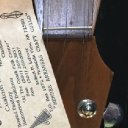
When I opened the case it still had the original pamphlet. I've attached some pictures. Anyway, my brother is really cool and I can't wait to get the modifications made. If anybody has any additions insights to this dulcimer maker or his instruments, please share.
Thank you,
Tom